Document 23: Sagittarius Part1

Updated: Dec 16, 2025
Sagittarius: The Archer and the Death of the Sun
Matthew 26:1–27:66 · November 22 – December 21
"From noon until three in the afternoon darkness came over all the land." — Matthew 27:45
The Astronomical Foundation: The Sun at Its Lowest
Judas hangs himself, and in the sky the sun slips out of Scorpius and enters Sagittarius. The year begins its final descent. As the sun moves into this sign in late November, it draws closer to the lowest point of its yearly path. These are the darkest days, when night seems to grow without limit and the light that once blazed at midsummer fades toward extinction.
By December 21 the winter solstice arrives — the moment when the sun reaches its southernmost point and appears to die.
For Matthew’s audience, the parallel between the crucifixion and the winter solstice would have been intuitive. They lived by the zodiacal calendar. Their work, their seasons, and their sense of the sacred were shaped by the sky. They knew this dark turning of the year, when the great light stands still.
The Stillness of the Sun and the Betraying Star
The word solstice comes from the Latin solstitium: sol for sun and sistere for to stand still. I have explained this pause many times in this series, but here, at the lowest point of the year, it returns for the last time. For 3 observable days, December 21, 22, and 23, the sun appears to pause. It neither rises higher nor sinks lower on the horizon. To ancient observers, the great light had stopped.
We know now that this stillness belongs to a predictable cycle. Ancient people did not experience the sky as a system of equations. They lived by what they could see. And what they could see, at this moment of the year, offered no assurance. The sun had reached its lowest point and had not yet turned back. Whether it would rise again was not yet visible in the heavens.
This uncertainty was not confined to the sun alone.
Other lights in the sky behaved in ways that resisted simple expectation. Among them was the brightest of all after the sun and moon: Venus.

Something strange happens to Venus.
For much of its cycle, Venus rises in the eastern sky before dawn, announcing the coming of the greater light. It does not shine on its own but reflects the sun’s brilliance. To those who watched the sky night after night, this made Venus a herald, a guide, a trusted sign that day was near.
It was this role that gave the star its name. Lucifer is a Latin word formed from lux, meaning light, and ferre, meaning to carry or bear. Literally, it means “light bearer,” the classical name for Venus when it appeared as the Morning Star, rising ahead of the sun. Latin writers used the term plainly and poetically, without moral or theological weight, to describe the brightest herald of dawn.
But Venus does not remain faithful to this role.
At certain points in its cycle, Venus vanishes from the morning sky. When it returns, it no longer rises ahead of the sun. It appears in the west after sunset. The same brilliant star that once announced the sun’s coming now abandons its post. Instead of heralding the light, it accompanies the onset of darkness. The Morning Star becomes the Evening Star.
From a modern perspective, this transformation occurs roughly every 19 months, when Venus passes to the far side of the sun relative to Earth. During this phase, Venus appears in the evening sky for approximately 7 to 8 months. But ancient observers did not experience this as orbital mechanics. They experienced it as betrayal.
A light that had been trusted to announce the day no longer did so. The star that once stood with the rising sun now stood with the night. It did not oppose the sun by force. It deserted it. The betrayal lay not in destruction but in withdrawal of allegiance.
This visible reversal shaped the language of later myth and scripture. When Jerome translated Isaiah 14:12 into Latin, he used lucifer because it was already the obvious celestial word for “morning star,” long before it became a proper name within Christian demonology. Isaiah preserves the image in explicitly celestial terms:
“How you have fallen from heaven,
O morning star, son of the dawn!
You have been cast down to the earth,
you who once laid low the nations.”
— Isaiah 14:12
Before it was theology, this was sky language. A fall. A casting down. A trusted light abandoning its place. The image does not describe the sun being overcome, but the Morning Star no longer standing with it.
I intend to explore this constellation of images in much greater detail later, but it is worth pausing here to note an intriguing parallel already present in the texts themselves.
In Revelation, Jesus identifies himself explicitly as “the bright Morning Star” (Revelation 22:16). This stands in deliberate contrast to Isaiah’s Morning Star that falls from heaven, a light that loses its place and its alignment.
The distinction resonates with another image Matthew places at the climax of his teaching. In the judgment scene of Matthew 25, the Son of Man separates the sheep from the goats, placing the sheep on the right and the goats on the left.
This is not an arbitrary moral diagram. In ancient symbolic language, the right side is the side of alignment and favor, the side that moves with the returning light. The left is the side of separation, associated with descent and loss.
Read together, these images suggest that judgment is framed not simply as reward and punishment, but as orientation. The Morning Star that remains faithful stands on the right. The one that falls stands on the left. The question is not power, but alignment with the light.
The heavens themselves appeared to tell a story of betrayal. At the moment when the sun stood still at the edge of extinction, its brightest herald no longer announced its return. The sky did not behave like a machine. It behaved like a drama of loyalty and loss, whose outcome could only be known after the turning came.
The light lay still. The year held its breath.
After three days, on December 25, the sun visibly begins to climb. The light is reborn.
Matthew stages the death of Jesus at this threshold. The cosmic rhythm becomes the narrative rhythm. The sun dies. The Son dies. Both lie still. Both rise on the third day. The sky and the Gospel speak the same language.
It is difficult not to notice that this same language of alignment appears again at the cross itself. Jesus is crucified between two criminals, one on either side. Both are condemned. Both are dying. Yet the Gospels present a sharp divergence. One mocks and accuses. The other turns toward Jesus and asks to be remembered.
Early Christian readers consistently understood the repentant thief as standing on the right, the side of favor and alignment. Once again, judgment is not framed as moral bookkeeping but as orientation at the threshold. In the darkest moment, one remains aligned with the light beside him. The other does not.
The Ancient Context: Solar Peril and Divine Stillness
Across the Mediterranean world, the approach to the winter solstice was understood as a season of cosmic danger. This was not poetic sentiment but practical belief that shaped medicine, agriculture, and religious observance.
Pliny the Elder (Natural History 2.6) describes the solstices as moments when the sun "halts" and when nature shows signs of strain. The turning points of the year were thought to bring instability in weather, health, and cosmic forces. The solstice was not merely a date but a threshold — a moment when the order of the world wavered.
Columella (On Agriculture 11.2) describes the period of the winter solstice as a time when animals weaken, disease in plants increases, and farmers must guard against loss. The land itself participates in the sun's decline.
Against this background of cosmic anxiety, the great religious traditions of antiquity placed their most important stories of divine death and renewal at exactly this threshold.
The Two-Part Pattern: Light at Solstice, Life in Spring
I focus on Dionysus and Osiris not because they are exotic parallels but because they were the clearest and most familiar expressions of the solar cycle in Matthew's own cultural world. His audience knew these stories. They understood solstice birth and spring renewal long before hearing the Christian story.
Dionysus
In several Greek traditions, especially among the Orphic communities, Dionysus was celebrated as born at the winter solstice. When the daylight began its slow return, worshippers cried out "The god is born," acknowledging the rebirth of light in its smallest, most fragile form.
But the birth of light was only the first movement. Dionysus passed through suffering and dismemberment in myth, torn apart by the Titans, his body scattered and reconstituted. His return was celebrated not at the solstice but in the early spring festivals, when the earth itself opened again and the vines stirred beneath the soil. His full renewal belonged to the season of rising life, not merely the season of returning light.
Osiris and Horus
Egypt placed the same drama on a cosmic scale. Temples such as Karnak and Abu Simbel are aligned to catch the solstice sunrise, the moment when the young sun god Horus is reborn — the return of light after the darkest point of the year.
Yet the full renewal of the world did not come until spring. That moment belonged to Osiris. His death symbolized the fading of life, his dismemberment the desolation of barren fields, and his rising the greening of the land when the Nile brought new life to the earth. Barley sprouting from his mummified body was the oldest agricultural symbol of resurrection in the ancient world.
The Pattern
The Egyptians separated what the sky itself separates. The return of light and the return of life are not the same event. They belong to two different seasons:
Solstice: The light is born
Spring: Life rises from the dead
Matthew follows the same cosmic grammar. Jesus is born at the solstice, the moment of returning light. Jesus rises at Passover, the moment of returning life. The Gospel places its two greatest events at the two most ancient stations of the year.
Light first. Life second.
The sky performs this cycle every year, and the greatest stories of antiquity shaped themselves around it. When Matthew places the birth and resurrection of Jesus at these two cosmic gates, he speaks a language his audience already knew — a language written in the heavens long before scripture existed.
Two Archers, Two Roles
Now we turn to the sign itself.
Sagittarius is unusual among the constellations: it is one of only a hand full that carries two distinct mythological identities, and Matthew's Passion draws on both. Understanding this duality is essential. The sign holds both the killer and the killed, the archer who shoots and the archer who is shot. The Passion requires both — the death that is inflicted and the death that is willingly accepted.
Nergal: The God of Inflicted Death
The Babylonians, who originated the zodiacal system that spread throughout the Hellenistic world, associated Sagittarius with Nergal — a centaur-like figure depicted firing an arrow from a drawn bow. Nergal was conceived as the god of war, plague, pestilence, and death. Ancient texts describe him as the deity who presides over the killing season.
This characterization aligns with the sun's passage through the constellation. During Sagittarius season, much of the natural world retreats into dormancy. Fields lie fallow. Animals hibernate or die. Vegetation withers. The ancients understood this as a time when the world itself was afflicted — struck down by the archer's arrow.
The imagery extends to the stars themselves. In Mesopotamian astronomical tablets, the Archer aims his weapon at the heart of Scorpius — at red Antares, the star whose Greek name means "rival of Ares," rival of Mars, rival of the god of war and death. The arrow of Sagittarius points directly at this bloody star.
In Matthew's narrative, Nergal is the force that condemns, tortures, and executes. The arrow finds its mark. The Son is struck down.
Chiron: The Archer Who Is Wounded
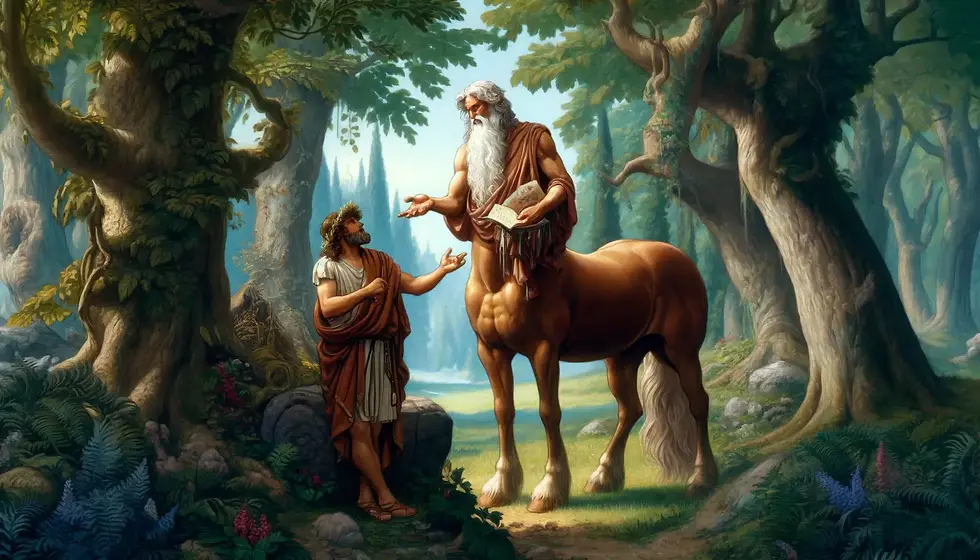
But Sagittarius carries a second identity: Chiron, the Greek centaur who is himself pierced by an arrow. Where Nergal inflicts the wound, Chiron receives it — and transforms it into redemption.
This is the mythological key to the Passion. The same sign that presides over the killing also presides over the willing sacrifice. Sagittarius is the house of death and the house of the death that saves.
The Wounded Healer: Chiron and the Breaking of the Curse
Chiron was no ordinary centaur. Born of divine parentage, he was immortal — deathless by nature. He was also the wisest of his kind, renowned throughout Greece as the master teacher. Achilles learned warfare from him. Asclepius learned medicine. Jason learned navigation. Chiron was healer, prophet, musician, and sage. He was, in the Greek imagination, the closest thing to a perfect being.
Then came the wound.
During a battle, Heracles accidentally struck Chiron with an arrow poisoned by the blood of the Hydra. The wound was incurable — not because Chiron lacked skill, but because the Hydra's venom was beyond all healing. The master physician could not heal himself.
Here was the cruelty: Chiron was immortal. He could not die. He was condemned to suffer the unhealable wound forever.
But there was another figure in Greek myth who also suffered eternally:
Prometheus.
The Curse for Bringing Light
Prometheus had stolen fire from the gods and given it to humanity. Fire meant light, warmth, technology, civilization — the elevation of mortals beyond their station. For this crime, Zeus condemned Prometheus to eternal torment: bound to a rock, an eagle devouring his liver each day, the organ regenerating each night so the torture could continue forever.
The curse stood. No god would lift it. Prometheus had given humanity the gift of light, and for this he would suffer without end.
Until Chiron.
The centaur, tormented by his own unhealable wound, offered Zeus a bargain: he would surrender his immortality — he would die — if Prometheus could go free. Zeus accepted. Chiron descended to the underworld. Prometheus was released. And Zeus placed the centaur among the stars as Sagittarius — the sign of the willing sacrifice.
The Parallel to Genesis
Set this beside the biblical narrative:
Prometheus | Adam and Eve |
Brings fire (light, knowledge) to humanity | Take fruit from the Tree of Knowledge |
Humanity is elevated — "like the gods" | Humanity's eyes are opened — "knowing good and evil" |
Zeus is angered at the transgression | Yahweh is angered at the transgression |
Prometheus is cursed with eternal torment | Humanity is cursed with death, exile, suffering |
The curse stands until a willing sacrifice | The curse stands until a willing sacrifice |
Chiron, the immortal, surrenders his life | Christ, the eternal Word, surrenders his life |
Prometheus is freed | Humanity is freed |
Chiron ascends to the stars | Christ ascends to heaven |
Both curses originate from the same primordial act: bringing knowledge and light to humanity. Both curses are broken by the same mechanism: an immortal being who willingly accepts death.
The Theological Inversion
But here the Gospel performs a profound inversion.
In Greek myth, the roles are distributed across multiple figures:
Zeus curses
Prometheus suffers
Chiron redeems
In the Gospel, these roles collapse into one:
God curses (Genesis 3)
Humanity suffers (the fallen condition)
God himself redeems (the incarnation and crucifixion)
In the popular telling the one who pronounced the curse becomes the one who breaks it. The judge becomes the sacrifice. This is not a distant deity accepting the death of another in humanity’s place. It is God entering the curse himself and dying within it.
The Greek pattern pressed in this direction, but the Gospel brings it to its full expression. The one who gives the curse and the one who ends it are the same.
Patristic Recognition
Early Christian interpreters recognized Chiron as a figure of Christ. They understood both stories as responses to the same cosmic pattern.
Clement of Alexandria explicitly names Chiron: "Even Chiron, though called immortal, was wounded and sought death for his relief; but the Logos, being life Himself, suffered that He might heal the sufferings of all."
Origen argues that such myths pre-echo divine truth: "These things which are said of those whom the Greeks call sons of gods contain certain obscure hints of the mystery of the Word."
Fulgentius makes the identification explicit: "Chiron, half man and half horse, signifies the teacher whose human part suffers that the brutish may be healed."
He reads the centaur's dual nature as Christ's two natures — divine and human. The wound is the cross. The ascent to the stars is the ascension.
The Sign of the Willing Sacrifice
Matthew places the Passion in Sagittarius — the constellation that is Chiron, the wounded healer who chose to die so that the cursed could go free.
Nergal fires the arrow. Chiron receives it.
The curse that began with light — with fire stolen, with fruit taken, with knowledge gained — is broken by the one who is Light itself, accepting the wound that no one else could bear.
Barabbas: The Two Sons of the Father
The trial before Pilate begins, and with it one of the most carefully constructed scenes in Matthew's Passion narrative. Beneath what appears to be a simple prisoner exchange lies a symbolic architecture that early Christian readers recognized and later Christian scribes attempted to obscure.
The Name
"Barabbas" is not a proper name. It is an Aramaic patronymic: Bar-Abbā, meaning "son of the father."
The implications are immediate. Jesus claims to be the Son of the Father — this is his central theological identity, the title that defines his relationship to God. Barabbas bears the same title as a name. When Pilate asks the crowd to choose between them, he is asking them to choose between two figures who carry the same essential designation.
One is the Son of the Father by nature and mission. The other is "son of the father" by name alone.
The Textual Evidence
The parallel runs deeper than patronymic. In some early manuscripts of Matthew 27:16–17, Barabbas is explicitly called Ἰησοῦς Βαραββᾶς — "Jesus Barabbas."
This detail appears only in Matthew. Mark, whom Matthew used as his primary source, calls the prisoner simply "Barabbas" (Mark 15:7). So does Luke. So does John. Matthew alone gives him the name Jesus.
This is not a scribal accident. It is an editorial decision. Matthew, working from Mark's account, chose to add a name that creates perfect symmetry: two men called Jesus, two men called "son of the father," standing before the crowd.
The manuscript evidence is sufficiently strong that many modern critical editions note "Jesus Barabbas" as a viable original reading. The question is not whether the variant existed but why it disappeared from most later copies.
Origen's Testimony
Origen of Alexandria, writing in the third century, provides direct testimony. In his Commentary on Matthew (121.7), he addresses the variant explicitly:
"In many copies it is not contained that Barabbas was also called Jesus... But perhaps the name was removed from the text out of reverence for the name of Jesus."
Origen is clear: he has seen manuscripts in which Barabbas is called Jesus, but he prefers the manuscripts that omit the name. His reasoning is theological, not textual — "no sinner should bear the name Jesus."
This passage establishes three facts:
The reading "Jesus Barabbas" was widespread in Origen's time
Scribes were actively removing "Jesus" from the name out of pious discomfort
Origen himself, despite his theological preference, acknowledges that the fuller reading is well attested
The textual history follows a familiar pattern: an original reading that created theological difficulty was quietly altered, leaving traces in older manuscripts and in the testimony of scholars who witnessed the transition.
The Original Scene
If "Jesus Barabbas" is the original reading, Pilate's question takes on a different character entirely:
"Whom do you want me to release to you: Jesus Barabbas, or Jesus who is called Christ?"
The crowd chooses between two men named Jesus. Two men designated "son of the father." The symmetry is total.
But this is not merely a choice between a criminal and a messiah. It is a choice between two visions of salvation — two understandings of what it means to be delivered.
Two Messiahs, Two Kingdoms
Jesus Barabbas was, according to Mark, a rebel who had committed murder during an insurrection (Mark 15:7). He represented the messiah the crowd expected: the warrior-king who would drive out Rome by force, restore Israel's political sovereignty, and establish God's kingdom through the sword. This was the outer messiah — salvation as external event, liberation as military victory, the kingdom seized by human hands.
Jesus called Christ offered something entirely different. His kingdom was, as John's Gospel puts it, "not of this world" (John 18:36). When asked when the kingdom would come, he answered: "The kingdom of God is not coming with signs to be observed... for behold, the kingdom of God is within you" (Luke 17:20-21).
Within you. ἐντὸς ὑμῶν. Not above, not beyond, not coming — but already present, interior, immediate.
This was the teaching that Paul would later crystallize in three words: "Christ in you" (Colossians 1:27). Not Christ above you, watching from heaven. Not Christ mediated through temple or priest. Christ in you — the hope of glory, the divine presence already alive within human consciousness.
The two Jesuses embody two completely different paths:
Jesus Barabbas | Jesus called Christ |
The outer messiah | The inner messiah |
Liberation through the sword | Liberation through awakening |
The kingdom seized by human hands | The kingdom recognized within |
Salvation as external event | Salvation as interior recognition |
God mediated through institution | God immediate in consciousness |
What the ego desires | What the ego fears |
Barabbas promised to fight the enemy outside. Jesus of Nazareth revealed that the only battle that matters is within — the surrender of the self that grasps, the dissolution of the barriers between the soul and the divine already present.
Why the Crowd Chose Barabbas
Matthew includes a detail that reveals the mechanics of the choice:
"But the chief priests and the elders persuaded the crowd to ask for Barabbas and to have Jesus executed." (Matthew 27:20)
The Greek word is ἔπεισαν — they persuaded, they talked them into it. The crowd did not spontaneously cry out for Barabbas. They were convinced by religious authority. The priests and elders — the institutional voice, the ones who claimed to speak for God — overrode whatever the people might have recognized on their own.
This is the pattern that repeats across all ages: the interior voice speaks, and institutional authority drowns it out.
The crowd stood before two men. Something in them might have seen the truth — might have recognized which Jesus embodied the presence of God. But they had been taught, across generations, that they could not trust themselves. They were fallen. They were broken. They needed priests to mediate, elders to interpret, authorities to tell them what God wanted.
So when the chief priests spoke, the crowd listened. The institutional voice overrode the interior witness. The letter silenced the Spirit.
This is why the outer messiah is always chosen. Not because humanity is incapable of recognizing the inner one — but because humanity has been persuaded that it cannot. Taught that its own knowing is suspect. Trained to defer to external authority in matters of the divine.
The outer messiah is comprehensible. He promises victory over enemies you can see, liberation you can measure, a kingdom you can rule. He demands only that you fight beside him.
The inner messiah is terrifying. He says the kingdom requires no fighting because it is already here, within. He says that what separates you from God is not Rome but your own grasping, your own refusal to see. He demands not your sword but your self — the surrender of everything the ego uses to define its existence.
Rome could handle a violent revolutionary. They would simply execute him — as they had executed many before and would execute many after. A man with a sword is a threat that can be defeated.
But a man who teaches that divine presence is immediately accessible within every person — that no temple, no priest, no institution stands between the soul and God — this is a threat that cannot be contained. Kill him, and the teaching remains. Silence him, and the interior witness still speaks.
The crowd chose the threat that could be defeated. They crucified the truth that could not be killed.
The Pattern That Repeats
Paul understood this dynamic with painful clarity. He described two ways of approaching God: the letter that kills and the Spirit that gives life (2 Corinthians 3:6). The written code, the external law, the mediated religion — these produce death. The interior presence, the Spirit that dwells within, the Christ who lives in you — this produces life.
But the letter always has its priests. The institution always has its elders. And they always stand ready to persuade.
For centuries, Christianity taught people to distrust the very voice that Paul called the Spirit. The immediate knowing — the interior teacher that needs no text, no priest, no permission — was labeled dangerous. Private judgment. Pride. The soul was told it was fallen, broken, incapable of recognizing God without mediation. Trust the institution. Trust the authorities. Trust anyone but the presence that speaks within.
And so the choice between Barabbas and Christ repeats in every generation. The crowd stands before two paths. Something within them recognizes the truth. And then the priests persuade.
Every institution that claims to mediate between humanity and God has already chosen Barabbas. Every theology that places salvation outside the soul — in correct belief, in proper ritual, in authorized priesthood — has already freed the outer messiah and crucified the inner one. Every voice that teaches humanity to distrust its own deepest knowing is the voice of the chief priests, persuading the crowd once more.
Patristic Recognition
Early Christian interpreters were not blind to this symmetry. The scene was so charged that it drew commentary from the earliest centuries.
Origen read the episode as the soul choosing between the violent impulse and the divine calling within. Humanity, given the choice, frees the one and crucifies the other. The pattern repeats wherever force is chosen over surrender, wherever the external is preferred to the interior.
Augustine commented on the bitter irony of the name — the crowd choosing one "son of the father" while rejecting another, unable to see that the title they honored in Barabbas was fulfilled only in Christ.
Jerome observed that the very structure of the scene — two men, same name, same title, opposite paths — suggested deliberate theological design rather than historical accident.
These interpreters understood what later scribes tried to soften: the Barabbas episode is not merely an incident in the trial narrative. It is a symbolic tableau, a choice placed before the reader as much as before the crowd.
Conclusion
The symmetry was sharp enough that some scribes preferred to obscure it, removing the name Jesus from Barabbas out of reverence and unease. The alteration follows the same pattern we have seen elsewhere: an original text that created interpretive difficulty was quietly changed, leaving traces in older manuscripts and in the commentary of scholars who witnessed the transition.
But the alteration, like the addition to Mark 11:13, confirms what it tries to conceal. Two Jesuses. Two sons of the father. Two paths to salvation. One freed, one crucified.
Matthew constructed the scene with precision. The crowd is not choosing between good and evil in simple terms. They are choosing between the messiah who promises external victory and the messiah who reveals interior presence — between the salvation that comes through the sword and the salvation that comes through surrender.
And Matthew tells us: they had to be persuaded. The chief priests and elders talked them into it. Left to themselves, the crowd might have chosen differently. The interior witness was there — it is always there. But the institutional voice was louder. The authority figures spoke, and the people, trained across generations to distrust their own knowing, deferred.
They chose the sword. They crucified the one who said the kingdom is within.
The priests are still persuading. The institutions still claim to mediate. The voice of authority still tells you that you cannot trust what you know in your deepest self, that you need an external savior, an outer messiah, a salvation located anywhere but within.
But the interior witness never stopped speaking. The Christ within still waits to be recognized. The kingdom is still here, still within, still immediate — requiring no priest, no permission, no persuasion.
The choice is offered still.
End of Part One
![[Post 08] The Markan Foundation: Narrative Shape and the Completion Model](https://static.wixstatic.com/media/e0a3b9_7a71ee36976d469d9921e0f8d5fe8721~mv2.jpg/v1/fill/w_980,h_535,al_c,q_85,usm_0.66_1.00_0.01,enc_avif,quality_auto/e0a3b9_7a71ee36976d469d9921e0f8d5fe8721~mv2.jpg)
![[Post 07] THE WINTER RETURN:](https://static.wixstatic.com/media/e0a3b9_731918ed00b540f18d13435dcb0c0027~mv2.jpg/v1/fill/w_980,h_535,al_c,q_85,usm_0.66_1.00_0.01,enc_avif,quality_auto/e0a3b9_731918ed00b540f18d13435dcb0c0027~mv2.jpg)
![[Post 06] THE AUTUMN RECKONING:](https://static.wixstatic.com/media/e0a3b9_44273715726b4c7ea4ea79842c9c7e44~mv2.jpg/v1/fill/w_980,h_535,al_c,q_85,usm_0.66_1.00_0.01,enc_avif,quality_auto/e0a3b9_44273715726b4c7ea4ea79842c9c7e44~mv2.jpg)
Comments