Document 21: Scorpius Part 1

Updated: Dec 14, 2025
Scorpio
Matthew 23:1 – 27:10 (tropical Scorpius: ~23 October – ~22 November)
Finding the Boundary
The sun has grown weak. The days contract. The air cools and hardens. This is the season when scorpions retreat into cracks and dark places, and in the ancient imagination they became emblems of deception, betrayal, and hidden danger.
The sting of early winter was likened to the sting of the scorpion. As the sun approaches its moment of death on the long descent through Scorpius, Jesus gathers his disciples for the final meal of the harvest year and announces that one of the twelve will betray him. The kiss that identifies the traitor becomes the human form of the sting.
The lines in Matthew are stark. “Whomsoever I shall kiss, that same is he. Hold him fast.” The Gospel enters the territory of the scorpion.
So does the sun. Not long after it passes through Scorpius and receives the kiss of the sting, it appears to be held fast at the winter solstice, caught in its brief standstill before the turning of the year.
The Yoke and the Sting: Marking the Threshold of Scorpio
Scorpius was never an easy boundary to fix. I am not convinced the evangelists intended strict edges at every point, and the text itself leaves room for movement. Yet my thesis requires that I mark the shift, even if the line is soft. What is clear is the theme that dominates this section. Judas carries the sign. The season does not start with the kiss so much as it is exposed by it. That one act of betrayal is the emblem of Scorpius in Matthew's story.
My first instinct was to place the boundary at Matthew 22:4: "My oxen and my fattened animals have been slaughtered." This is the only explicit bovine reference in the entire Gospel. It could have served as a natural signal from Taurus to Scorpius, especially since these two signs face each other across the zodiac. By that stage I had already noticed how Matthew links opposing signs in several places, so the idea seemed plausible.
This linking has a simple astronomical basis. In the zodiac, the sign that fills the night sky is always the one opposite the sign where the sun resides. When the sun enters Scorpius, Taurus rises into full view after sunset and governs the night. The two signs define one another through this day-night pairing, which makes an opposite pair a possible marker for a shift in the narrative. Matthew makes use of this pattern more than once, which is why this verse caught my attention at first glance.
But Matthew never used oxen to mark Taurus in the first place. He avoided the obvious image and shaped Taurus instead through the more subtle language of yokes, burdens, and the weight placed upon the shoulders of those who labor. And because the verses after 22:4 move back into taxes and civic obligations, the tone still belongs to Libra. The transition has not yet taken place.
Still, Taurus would already be visible during Libra. As the year moves into that sign, another quiet shift takes place in the sky. In the last days of August and the opening weeks of September, while the harvest is being gathered and the scales of judgment prepare to turn, the full head of the Bull rises again in the pre-dawn hours. Aldebaran breaks free of the summer haze, the Hyades sharpen into their V-shaped face, and the Pleiades climb just ahead of sunrise.
By late October, as Libra yields to the deepening night of the year, Taurus moves into full evening visibility and begins to dominate the winter sky. In ancient Judea the gradual return of the Bull marked the point in the year when farmers began preparing their fields once more, turning the soil for the next round of planting. As Libra weighs the fruit of the old year, Taurus is already rising to announce the work of the next.
To understand why Matthew 23 functions as the true threshold, one must first understand how Matthew constructed Taurus. In the ancient zodiac, Taurus is the laboring sign. The Bull is defined by weight, work, and the strain carried on the shoulders of those who toil. Its iconography is inseparable from the yoke—the wooden beam laid across the neck and shoulders of oxen to harness their strength for plowing.
The yoke is not merely associated with Taurus. It is Taurus. The constellation itself was understood as the great beast of burden whose labor makes the earth fruitful. This is why the agricultural calendar placed Taurus in spring. The Bull marks the season of plowing, when the fields are broken and prepared for seed. The work is heavy. The yoke is real. And the shoulders of the ox bear the weight of the year's hope.
Matthew places the image of the yoke at a precise moment in his Gospel:
"Come to me, all you who are weary and burdened, and I will give you rest. Take my yoke upon you and learn from me, for I am gentle and humble in heart, and you will find rest for your souls. For my yoke is easy and my burden is light." (Matthew 11:28–30).
The passage is saturated with Taurus imagery: weariness, burden, the yoke, rest for those who labor. But Jesus inverts the expectation. The yoke of Taurus is heavy; his yoke is easy. The burden of the laboring ox is crushing; his burden is light. He does not abolish the sign—he fulfills it. He offers what Taurus promises but cannot deliver on its own: rest for the weary, relief for the burdened. This is not a rejection of work. It is the redemption of work. The Bull's labor finds its gentle counterpart in a teacher who shares the load.
This is why the opening of Matthew 23 functions as the better threshold. Jesus turns to the crowds and his disciples and declares:
"They tie up heavy, cumbersome loads and put them on other people's shoulders, but they themselves are not willing to lift a finger to move them" (Matthew 23:4).
Matthew is not invoking an ox here. He is deliberately returning to the yoke language he used earlier to shape Taurus—the sign he defined through burdens, weight, and the strain placed on the shoulders of those who labor.
The same imagery returns: burdens, shoulders, the weight placed on those who labor. But now the yoke is inverted. In Matthew 11, Jesus offered a yoke that relieves. In Matthew 23, the leaders impose a yoke that crushes. One image frees the worker. The other traps the worker. One fulfills the promise of Taurus. The other breaks it.
This inversion is not accidental. In the zodiac, Taurus and Scorpius stand opposite each other on the wheel. They form an axis—the line that runs through the center of the circle, connecting two signs that mirror and oppose one another. Taurus governs spring; Scorpius governs autumn. Taurus is the season of plowing; Scorpius marks the harvest's end. Taurus carries the yoke; Scorpius carries the sting. Taurus is defined by labor; Scorpius is defined by betrayal. In Taurus the burden is shared; in Scorpius it is imposed. Matthew places the compassionate yoke in the territory of Taurus. He places the crushing yoke at the doorway of Scorpius. The axis holds.
And here is where the oxen of Matthew 22:4 find their purpose. With the only direct bovine reference in the entire Gospel appearing in the preceding chapter, it feels almost as if Matthew is priming the reader to pay closer attention—setting up an echo of Taurus so that we recognize the shift when it arrives.
The slaughtered oxen are not the boundary marker themselves. They are the preparation. They awaken the reader's attention to the Bull so that the yoke language of Matthew 23 lands with full zodiacal weight. The true marker appears at the start of the next chapter. The oxen prime. The yoke signals. And the zodiacal house where Judas will soon step forward opens its door.
By echoing the yoke imagery at this precise moment, Matthew signals that the season has turned. The old rhythm of Taurus—the gentle invitation to shared labor—has passed. The Gospel is crossing into darker territory. The next sign will not concern the sharing of burdens but the approach of betrayal. Judas belongs to Scorpius. The kiss belongs to the scorpion. The sting that kills belongs to Scorpius. The yoke that once promised rest now tightens into a trap. The shoulders that once bore a light burden will soon bear a cross.
Matthew 23:4 is not merely a critique of hypocrisy. It is a zodiacal hinge. The Bull gives way to the Scorpion. And the reader, if attentive, feels the shift in the weight of the world.
Why Judas
Judas belongs to Scorpius not because of fictional modern zodiac personality traits, but because the ancient world already associated the Scorpion with everything Judas becomes. In ancient myth the Scorpion kills the hero, signals the decline of the sun, strikes through contact, guards the gate to the underworld, acts secretly at night, and marks the season when the world begins to die.
Judas repeats every one of these themes in human form. He is the sting that turns the story toward its darkest arc. He is the Scorpion walking through the Gospel.
The way the Gospel writers deploy the Judas figure raises the question of how much remembered biography remains in the tradition. In both Mark and Matthew, the character functions with striking precision and minimal psychological development, entering the narrative only when required and disappearing once his role is complete. This makes it difficult not to wonder whether the evangelists were working primarily with a symbolic role rather than with detailed historical memory. This remains a suspicion rather than a conclusion, and nothing in the present argument depends on it.
After seeing how certain names and narrative elements in Matthew carry hidden layers of meaning, many of which I plan to explore elsewhere, it seemed inevitable that the name Judas would also contain a deeper resonance. And thanks to modern AI tools, it took only a few seconds to uncover what I believe is one of the strongest pieces of evidence in the entire thesis, a discovery that clarifies the symbolic intention behind the character more sharply than anything I had seen before.
The Inversion of Judas
The word σκορπίον (scorpion) appears only six times in the entire Old Testament. It never appears in Matthew. It never appears in Mark, the source on which Matthew builds. Across the whole scriptural world accessible to Matthew and to his audience there is only one place where the word appears with any real force and visibility. That place is the Books of Maccabees. These books were widely read, deeply respected, and preserved in the Septuagint which served as the Bible for Greek speaking Jews and for the earliest Christian communities.
In 1 Maccabees 5:3 the text mentions a region that English Bibles usually leave as Akrabattene or Arabattine. The Greek preserves the name as Ἀκραβαττίνη. The Hebrew behind it is Akrabbim which means Ascent of the Scorpions. Anyone familiar with the Semitic root would hear the meaning immediately. Yet English translations almost never render it into ordinary speech. The name carries its symbol in plain sight, but the symbol is concealed when left untranslated.
In 1 Maccabees 6:20 the Seleucid army brings siege engines against Jerusalem:
μηχανὰς καὶ καταπέλτας καὶ σκορπίουςmachines and catapults and scorpions
The word appears again in 1 Maccabees 6:51. These two verses contain the only explicit appearances of σκορπίον in all of Jewish scripture that Matthew’s readers would have known.
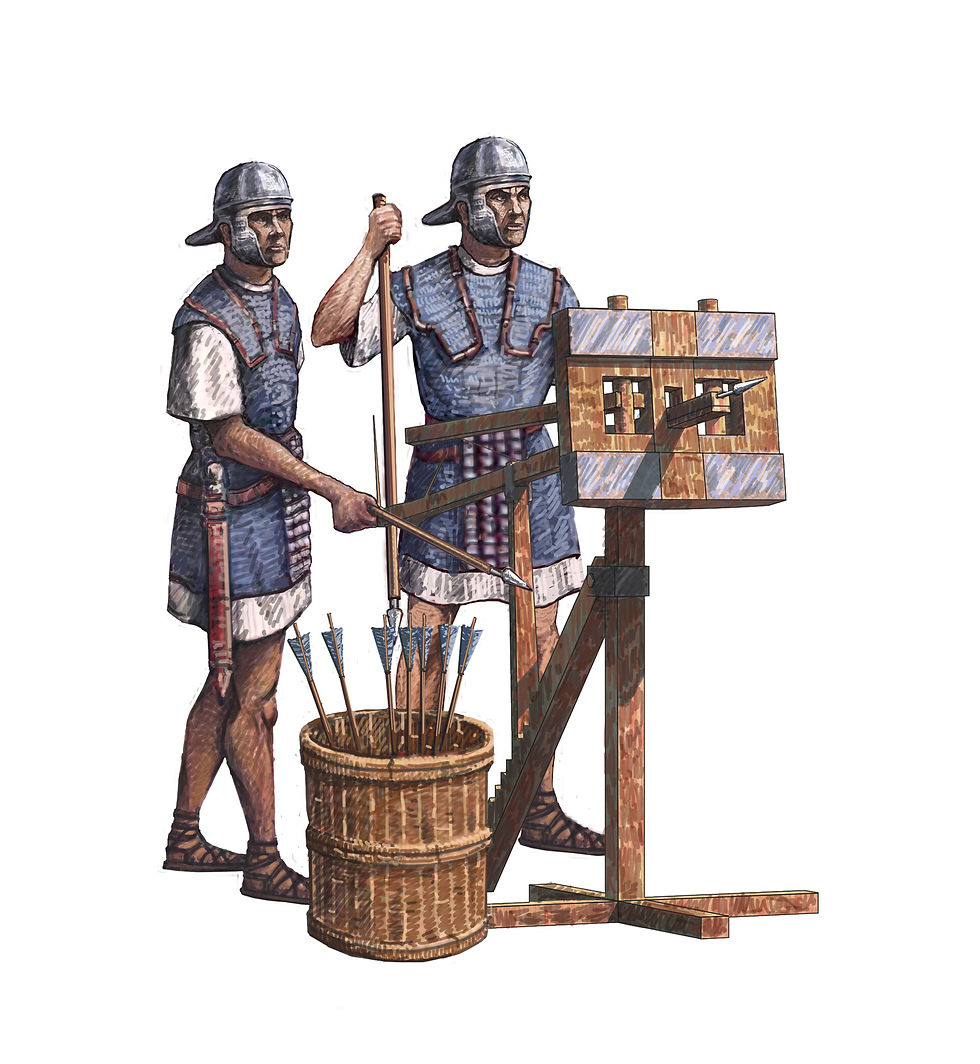
The term is not a specialist military designation. It is simply the Greek word for scorpion — the same word used for the creature, the same word used for the constellation, the same word used for the sign of the zodiac.
The siege engine takes the name because of what it does. It releases a bolt with sudden speed. It strikes from a distance before the victim can react. The action resembles a sting and so the weapon receives the creature’s name.
The hero who led the defense against them was remembered as the commander who led the successful revolt against the Seleucid Empire in the mid second century BCE. He restored temple worship, defeated far stronger armies, and reclaimed Jerusalem. His rededication of the Temple became the origin of Hanukkah. Each year the festival retold his victory. The lights recalled the return of freedom. The eight days remembered the cleansing of the sanctuary and the renewal of the altar. In Jewish memory this placed him alongside the great deliverers of Israel. His victories were told as legends of courage, divine favor, and national renewal.
His name was Judas Maccabeus. The greatest Jewish hero of the Second Temple period. The liberator who drove out the foreign occupiers. The warrior who purified the Temple and restored its worship. The man whose triumph is celebrated every year at Hanukkah. He is the defender of Jerusalem. He is the one who resists the scorpions, the σκορπίον that threatened the holy city.
Matthew never writes the word. But he creates a figure who embodies the word. He gives him the only name that, in the Jewish imagination of the period, was inseparably linked with scorpions and famously so.
Every Jewish reader of Matthew's Gospel would have known this name. Judas was not a name chosen at random. It was the name — the name of resistance, of faithfulness, of the one who stood between the sacred and its enemies. To hear "Judas" was to hear "hero."
And Matthew gives this name to the betrayer.
The Sicarii Link: Why "Iscariot" is the Sting in the Tail
People often hear the idea that Judas was connected to the Sicarii, the “Dagger Men,” and wonder if that is even possible. Historians usually dismiss it immediately. They argue that Judas could not have been one of the Sicarii because the organised group does not appear until the 50s CE, long after Jesus died. To them this makes the theory anachronistic. They treat it as a timeline problem. Case closed.
But that objection rests on a narrow modern way of thinking. It assumes that Matthew cared about the precise start date of a political faction. He did not. The author worked with symbols, names, and the emotional memory of the world he lived in. What mattered was not the historical timeline but the literary one.
Matthew wrote in the 80s CE, after the Jewish War. By then everyone knew who the Sicarii were. They were the radical assassins who hid small curved daggers under their cloaks, slipped into festival crowds, struck without warning, and vanished before anyone could react. They betrayed priests, aristocrats, and their own people. Their hidden violence helped ignite the revolt that led to the destruction of Jerusalem.

For people living in that world the word Sicarius meant treachery from inside the crowd. It meant a sudden strike at close range. It meant fear of the man standing beside you. The name carried the sting of danger.
So why did anyone think Judas Iscariot was linked to this? Because the evidence leans in that direction naturally.
First, the name itself
The link does not come from how Iscariot sounds in modern English. It comes from how the name would have been heard in Aramaic. One early explanation points out that a Semitic rendering of Sicarius could easily become something like:
Sikari → Iskari → Iskariotes
Greek writers often added a final tes to foreign names.Latin s often softened in Semitic mouths.Aramaic forms beginning with sak or siq could become isk when borrowed.
In other words, Sicarius moves through a Semitic accent and comes out in Greek as something remarkably close to Iscariot. That is why older linguists noticed the connection long before modern theories. It is not about English sound. It is about the ancient transliteration pathway, which makes the link entirely plausible.
Second, Judas behaves like a dagger man
He moves within the circle of disciples.He hides his real intention.He gets close.He delivers the strike with a kiss.This is exactly the pattern people associated with the Sicarii.
Third, Matthew is not writing a biography
He is shaping a symbolic story. In his zodiac structure Judas belongs to Scorpio, the sign of betrayal, death, and the hidden sting. This is where the name Iscariot becomes essential. If Iscariot simply means “a man from Kerioth,” the name carries no symbolic weight. It is just geography. But if Iscariot echoes Sicarius, the dagger man, then the name itself reveals the role. It marks Judas as the one who carries the hidden weapon. It turns him into the human form of the scorpion’s sting.
This is why the Sicarii connection matters. It does not depend on whether Judas belonged to a later organised faction. It depends on how the name sounded to Matthew’s audience, what imagery it triggered, and how the author used the character.
When Matthew writes “Judas Iscariot,” his readers hear something far sharper than a town reference.They hear Judas the dagger man.Judas the hidden threat.Judas the sting inside the circle of disciples.
And in the Scorpio section of the Gospel, that is exactly who he must be.
So when Mark first chose the name it was not carelessness. It was precision. Mark introduces Judas with a title that already carried an air of danger, a name that sounded wrong, sharp, and out of place among the Twelve. He gives no explanation because none was needed. The audience knew the reputation of dagger men. They knew the sting that comes from within the crowd. The name itself does the work.
Matthew then takes what Mark began and builds a symbolic inversion so total, so deliberate, that it cannot be accidental. He takes the most celebrated name in Jewish memory, the name of Judas Maccabeus, the liberator, the hero who resisted the scorpions, and flips it. He turns Judas into the scorpion’s sting. He becomes the inner strike that brings down the king. A complete reversal. A theological shock.
Nothing in this construction is casual. The choosing of the name is exact. The placement is exact. The function in the zodiac sequence is exact. Mark plants the seed. Matthew lets it bloom into a symbol that reverses the national hero and reveals the sting that must appear in Scorpio.
Judas Maccabeus | Judas Iscariot |
Defender of the Temple | Betrayer of the true Temple |
Protector of Jerusalem | Insider who hands over the King |
Victim of the σκορπίον | Human σκορπίον within the circle |
Symbol of Jewish faithfulness | Symbol of collapse from within |
Resists the sting | Delivers the sting |
Fights to preserve | Acts to destroy |
Celebrated at Hanukkah | Remembered as the archetype of treachery |
One Judas stands against the scorpion.
The other Judas becomes the scorpion.
The name that meant "defender against the sting" now means "the one who stings." The name that meant faithfulness now means betrayal. The name that saved the Temple now sells the one who is the Temple.
Matthew is not simply telling a story about a man who betrayed Jesus. He is inverting the most sacred symbol of Jewish resistance. He is saying: what once defended the holy place now destroys it from within. The σκορπίον is no longer outside the walls. It sits at the table. It shares the bread. It knows where the Master will be found in the dark.
And the sting comes with a kiss.
This is not allegory loosely draped over history. This is symbolic architecture built with devastating intention. Matthew places Scorpius at the hinge of the Passion. He names his Scorpius figure after the one Jewish hero most associated with resisting the σκορπίον. He makes that figure the agent of death, the secret-keeper, the nighttime operator, the one whose act opens the door to the underworld.
The scorpion engines that once fired at Judas now fire through him.
If Matthew is writing at the level we have been tracing — aligning his Gospel with the zodiac, embedding astronomical markers in names and numbers and narrative structure — then this is his most explosive stroke. He has taken the sign of Scorpius and fused it with the most revered name in recent Jewish memory, then inverted everything that name once meant. The defender becomes the destroyer. The faithful one becomes the faithless one. The one who protected the sacred space becomes the one who sells it for silver.
The theological implications are staggering. Matthew is not merely recording a betrayal. He is constructing a statement about the end of an age. The institutions that once defended the covenant have become the instruments of its undoing. The Temple that Judas Maccabeus saved will fall within a generation of Judas Iscariot's kiss. The σκορπίον is no longer at the gates. It has been inside all along.
And when the sting is delivered, the story turns toward the darkness that must come before the sun can rise again.
The Two Clocks of Matthew 24
The Inner Rooms, the Upper Room, and the Turning of the Ages
Introduction: Two Concurrent Timelines
To read Matthew 24 with clarity, two clocks must be held together. Matthew is not describing a single timeline. He is describing the friction between two concurrent temporal systems: the small clock of the solar year—the cycle of seasons, winter, and harvest—and the great clock of the precessional ages, the slow, majestic turning of the cosmic eras.
The Mount of Olives Discourse opens with a precise question from the disciples: "What will be the sign of your coming and of the end of the age?" The Greek word here is αἰών (aiōn)—not the end of the physical world, but the end of an era, the close of a cosmic span of time. The disciples are asking about the turning of the great wheel. And Jesus answers them by dismantling the small clock to reveal the large one.
I. The First Clock: Winter on the Horizon
The language of Matthew 24 is saturated with the imagery of approaching winter. The narrative has been following the solar year from its beginning, and now the story bends toward the dark portion of its journey. The teachings echo the real hardships of the coming season: shrinking days, rising cold, hunger, illness, danger in the night.
Consider the references gathered in barely thirty-five verses: "There will be famines"—in an agrarian world, famine is not abstract catastrophe but the hungry gap when stores run low and fields stand bare. "The love of most will grow cold"—the Greek word psychō appears only here in Matthew and literally means "to blow," "to cool," or "to chill." Matthew had numerous words available for moral decline; he chose the one that evokes winter.
"Let no one in the field go back to get their cloak"—the himation is the outer garment used for warmth at night, protected by Torah as a life-sustaining item that must be returned before sunset. "How dreadful it will be for pregnant women and nursing mothers"—winter is the hardest season for the most vulnerable. "Pray that your flight will not take place in winter"—the only time Matthew mentions winter in the entire Gospel.
Most striking is the phrase: "If those days had not been cut short, no one would survive." Matthew states it twice. What becomes conspicuously shorter as the dark season arrives? The days themselves. In ancient life without artificial light, this was not a minor observation—it was the governing fact of daily existence. Matthew places language about shortened days precisely where the calendar would make that shortening most apparent, and he says it twice. The signal is not hidden.
Then comes the culminating image: "The sun will be darkened, and the moon will not give its light; the stars will fall from the sky." This is the nadir. The lowest point of the solar year. At the winter solstice the sun reaches its deepest descent and appears to stand still for three days—the word solstice itself means "sun standing still." For three days the light seems to die. Then, around December 25th, the rebirth becomes perceptible.
The first clock is clearly present. The sun is moving toward its deepest descent. The language of the discourse follows it down.
II. The Second Clock: The Great Wheel Revealed
But behind the seasonal clock ticks a second, vaster mechanism. When Jesus speaks of αἰών, he is not describing the end of a solar year or a moment of biological resurrection. He is placing himself at the hinge-point when one cosmic age ends and another begins. In zodiacal terms, this is the fading of the Age of the Ram and the birth of the Age of the Fish.
The precessional cycle—the slow wobble of Earth's axis that causes the spring equinox to drift backward through the zodiac over approximately 26,000 years—was known to ancient astronomers. Each "age" lasts roughly 2,160 years, the time required for the equinox point to traverse one zodiacal sign. For over two thousand years before Jesus, the world had turned under the sign of Aries, the Ram. The Ram was the solar engine of the previous age. But as Jesus speaks, the Age of Aries is ending. The equinox is shifting into Pisces, the Fish.
III. The Inner Rooms and the Wrong Wheel
The warning Jesus issues in verse 26 is typically read as a simple caution against false messiahs, but the language suggests a specific cosmological rejection:
"So if anyone tells you, 'There he is, out in the wilderness,' do not go out; or, 'Here he is, in the inner rooms,' do not believe it."
These are not random images. The wilderness is where the young sun appears just after the solstice—weak and newly born, not yet strong enough to signal the full revelation. It is the wrong time.
The "inner rooms" (ταμεῖον, tameion) carried symbolic meaning in ancient cosmology. The term referred to hidden interior chambers of a house, but it also evoked the twelve small divisions of the horoscopic zodiac—the narrow compartments of the lesser wheel used by astrologers to predict individual fate. These are the small rooms of the heavens, the confined sectors where the sky is domesticated for daily use.
Jesus refuses this frame. He tells the disciples not to look there. The coming of the Son of Man cannot be calculated within the little rooms of the zodiacal houses. It does not belong to the smaller wheel of personal fortune or annual prediction. The revelation will not occur in the confined chambers of the twelve small rooms.
He contrasts the claustrophobia of the tameion with the vastness of the horizon:
"For as lightning that comes from the east is visible even in the west, so will be the coming of the Son of Man."
This is the scale of the great wheel. The movement is not hidden in a secret chamber; it is written across the entire sky. It spans from East to West, mirroring the great precessional slide of the heavens. What is it that comes from the east and is visible even in the west? What crosses the entire sky, unmistakable to every observer? The sun. Every day, without exception, it rises in the east and sets in the west. The comparison is astronomical, and it is transparent: the coming of the Son of Man follows the pattern of the sun's return after the solstice—directional, visible, the reversal of darkness.
The verse warns against false reports precisely because the real coming will not be local. It will not be secret. It will be like the sun—everywhere at once, visible from horizon to horizon. No one needs to be told where the sun is. The revelation belongs to the vast motion of the ages, the cosmic circle that determines the rise and fall of eras. It cannot be hidden, and it cannot be confined.
The inner rooms are the wrong wheel.
IV. The Carcass of the Ram
If the lightning reveals the scale, the imagery of the carcass reveals the timing:
"Wherever there is a carcass, there the vultures will gather."
This cryptic phrase is typically treated as a generic proverb of doom. But in the context of the precessional argument, it becomes a celestial marker. For over two thousand years, the world had turned under the sign of Aries, the Ram. The Ram was the living vessel of the sun in the previous age. Now, as the equinox shifts, the Age of Aries is ending.
The Ram is no longer the living vessel. It is a carcass.
The vultures gathering—the birds of the air—signal that the old cycle is dead. The heavens are being picked clean of the old symbols so that the new age may begin. The "end of the age" is the death of the Ram.
And here the Gospel of John provides the key that unlocks the full meaning. When John the Baptist first sees Jesus, he declares:
"Behold the Lamb of God, who takes away the sins of the world" (John 1:29).
Jesus is the Ram. He in his mortal life embodies the dying age. The Passover lamb, slain at this very moment in the narrative, enacts what the heavens are performing on a cosmic scale.
The crucifixion is not merely an execution. It is the cosmic slaying of Aries. And the resurrection is not merely personal revival—it is the birth of the new age. Jesus dies as the Lamb; he rises as the Fish. The "sins of the world" that the Lamb takes away are the worn-out symbols of the old era, the exhausted order of the previous age, cleared away so that Pisces may begin.
The historical confirmation came within a generation. Jesus was proclaimed as the final sacrifice—the Lamb whose death ended the need for further lambs. And in 70 AD, the Temple fell. The daily tamid offerings—a lamb sacrificed each morning and evening to Jehovah—ceased permanently. For centuries, the ram had been slain twice daily on the altar. Now the altar itself was gone. The sacrificial system that had defined the Age of Aries ended not gradually but absolutely.
The Ram died on every level simultaneously: cosmically in the precessional shift, theologically in the crucifixion, and historically in the destruction of the Temple. The Age of Aries was not merely ending—it was being dismantled. The carcass was real. The vultures had gathered. And the new age had begun.
This is why the early Christians adopted the fish (ichthys) as their secret symbol. It was not arbitrary. It was cosmologically precise. They understood themselves to be living in the Age of the Fish, inaugurated by the death of the Ram and the resurrection of the one who had embodied him.
V. Birth Pains and the Axis of Change
As the Ram dies, the new age struggles to be born. Jesus speaks of "birth pains" (Matthew 24:8), a phrase that resonates with the mechanics of the great wheel.
The zodiac operates on an axis. As the sun moves into the Age of Pisces (the Fish) at the spring equinox, the opposite side of the wheel falls into Virgo (the Virgin) at the autumn equinox. The axis of the new age is Pisces-Virgo.
When Jesus says, "How dreadful it will be in those days for pregnant women and nursing mothers," he is grounding the prophecy in this celestial alignment. The imagery hearkens to the Virgin who gives birth, the zodiacal counterpart to the Fish. Virgo is the mother, the womb of the heavens. Virgo gives birth to the Fish.
The "birth pains" are the cosmic tension of this shift—the violent transition as the massive gears of the sky grind from one era to the next. All the images of pregnant women, nursing mothers, and fleeing in winter align with this theme. They point back to Virgo, the sign of the mother, preparing to deliver the new age.
VI. The Man Carrying the Pitcher: A Deliberate Anomaly
The distinction between the two clocks reaches its culmination in the preparation for the Last Supper, where a divergence between Matthew and Mark reveals the full architecture of the prophecy.
In Mark 14:13, the instructions are explicit:
"Go into the city, and a man carrying a jar of water will meet you. Follow him."
In first-century Judea, men did not carry water jars. Drawing, carrying, and storing water was almost universally women's work. Women fetched water from wells; women carried water jars on their heads or shoulders. Men carried skins, not jars, and usually only for animals or long travel. Every ancient listener would have paused at this detail. A man carrying a water jar is a deliberate anomaly—a signal that points elsewhere.
There is only one figure in the ancient heavens who is literally portrayed as a man carrying a jar of water: Aquarius. The image is exact—a man carrying a jar, pouring water, standing at the boundary of Pisces and Aquarius in the sky. This is not symbolic coincidence. It is a direct reference.
The Precessional Logic
On the annual zodiac, Aquarius precedes Pisces as the sun moves forward through the signs. But on the precessional zodiac, the motion runs backward. The equinox drifts: Aries → Pisces → Aquarius → Capricorn. The age that follows Pisces is Aquarius. But the sign that leads you into Pisces—that stands at its threshold as the herald of the new age—is also Aquarius.
The man carrying the pitcher therefore performs a cosmic role. He is the herald who points the disciples to the place where the final meal of Aries will occur. He guides them to the transition point where the Ram gives way to the Fish.
VII. The Two Rooms: Tameion and Anagaion
Mark then adds a crucial detail:
"He will show you a large room upstairs, furnished and ready. Make preparations for us there."
Here the contrast becomes architectural. Jesus warned the disciples against the tameion—the "inner rooms" of the small wheel. But he leads them to the anagaion—the "upper room."
The inner room is the small, hidden place of the lesser clock. The upper room is the high, open place of the greater clock.
In Mark, the Man with the Pitcher (Aquarius) shows the way to the upper room because the great wheel moves forward. The sequence is clear: Aries (Ram/Carcass) → Pisces (Jesus/Fish) → Aquarius (Water Bearer). Mark provides the full chronological map of the precessional ages.
VIII. Matthew's Editorial Decision
Matthew, however, alters the focus. In Matthew 26:18, both the Man with the Pitcher and the "large room upstairs" are omitted. The disciples are simply told to go to "a certain man."
Why? Because Matthew has already built his zodiacal contrast in chapter 24. He has already dismissed the "inner rooms" of the small wheel and oriented the reader toward the great wheel that governs the ages. If Matthew kept Mark's Aquarius signal, he would introduce a second zodiacal pointer at the very moment he wants the narrative to stay focused on the death of Aries and the birth of Pisces.
So Matthew tightens the symbolic logic:
In chapter 24 he rejects the inner rooms.
In chapter 26 he omits the large room.
He keeps the narrative focused on the transition between Aries and Pisces.
Matthew simplifies the zodiacal geography so that the emphasis remains clear. He keeps the Passover symbolism (Aries). He keeps the fish symbolism throughout his Gospel. He removes Aquarius to tighten the symbolic focus. He preserves the transition of the age, not the architecture of the entire zodiac map.
Mark wants to show the larger structure. Matthew wants to show the specific transition. Both are internally consistent, but their aims differ.
Conclusion: The Convergence of the Clocks
What emerges from this analysis is a single, coherent argument: Matthew is guiding the reader from the winter descent of the solar year to the dawn of a new cosmic age. The small wheel and the great wheel converge.
The first clock—the solar year—provides the texture of the discourse: winter, cold, shortened days, flight, suffering. This is real. By the time the first Gospels were being written, the Temple had already fallen, war had already come, and famine had already struck. The discourse gave meaning to catastrophe. It told the survivors: this was foreseen. This belongs to a larger order. That winter was always coming.
But behind the seasonal clock ticks the second clock—the precessional ages—which provides the meaning. The αἰών is ending. The inner rooms are empty. The wilderness is a distraction. The Ram is a carcass. The true sign is written in the geometry of the heavens: the lightning flash of the precessional shift, visible from East to West.
The disciples are being taught to stop reading the small clock of fortune and start reading the great clock of God.
The mourning and the glory are not contradictions. They are the two faces of every solstice, every transition, every death that becomes a resurrection. The peoples mourn because something has ended. They witness glory because something has begun.
The Sun of Man rises. The Ram yields to the Fish. And the story continues—now in the Age of Pisces.
![[Post 08] The Markan Foundation: Narrative Shape and the Completion Model](https://static.wixstatic.com/media/e0a3b9_7a71ee36976d469d9921e0f8d5fe8721~mv2.jpg/v1/fill/w_980,h_535,al_c,q_85,usm_0.66_1.00_0.01,enc_avif,quality_auto/e0a3b9_7a71ee36976d469d9921e0f8d5fe8721~mv2.jpg)
![[Post 07] THE WINTER RETURN:](https://static.wixstatic.com/media/e0a3b9_731918ed00b540f18d13435dcb0c0027~mv2.jpg/v1/fill/w_980,h_535,al_c,q_85,usm_0.66_1.00_0.01,enc_avif,quality_auto/e0a3b9_731918ed00b540f18d13435dcb0c0027~mv2.jpg)
![[Post 06] THE AUTUMN RECKONING:](https://static.wixstatic.com/media/e0a3b9_44273715726b4c7ea4ea79842c9c7e44~mv2.jpg/v1/fill/w_980,h_535,al_c,q_85,usm_0.66_1.00_0.01,enc_avif,quality_auto/e0a3b9_44273715726b4c7ea4ea79842c9c7e44~mv2.jpg)
Comments