Document 16: Gemini

Updated: Dec 5, 2025
Gemini (May 21 to June 21) — Matthew 12:22 to12:37 (Solstice 12:38 to 12:48)
Agricultural Reality in Judea: This is the heart of the wheat harvest. Winnowing, sorting, and separation of wheat from chaff dominate work. Pentecost corresponds to the closing of the wheat harvest. This is one of the most clearly documented parts of the Hebrew agricultural calendar.
The Twins, Division at the Summer Solstice
The Astronomical Context: Approaching Maximum Light
Across cultures, the constellation of Gemini has been seen as twin figures—Castor and Pollux for the Greeks, but echoed in paired deities and heroes throughout the ancient world. Twins embody unity and separation, likeness and difference, reflection and opposition.
As the sun enters Gemini in late May, it climbs toward its zenith at the summer solstice, the longest day of the year. This was the season of abundance, when crops flourished and life overflowed.
At the solstice, the sun appears to pause for three days at its northernmost point before turning back toward decline.
The word solstitium itself means "sun standing still," from sol (sun) and sistere (to stand still). This pause divides the year in two. Six months of waxing light give way to six months of waning darkness. The division is not merely temporal. In ancient cosmology, the solstice represented a hinge in the cosmic order, the moment when ascent pivots to descent.
Matthew's Gospel enters this threshold with extraordinary precision.
The Triple Alignment: Three in the Third Sign
If the zodiacal structure holds, one alignment becomes difficult to dismiss. Gemini is the third sign of the zodiac. The summer solstice marks a three-day pause when the sun stands still. And it is exactly here, in Matthew's third zodiacal section, that the number three appears for the first time in the Gospel:
"For as Jonah was three days and three nights in the belly of a huge fish, so the Son of Man will be three days and three nights in the heart of the earth" (12:40).
The correspondence is striking. The third sign. The first explicit mention of "three." The three-day solstice pause. The prophecy looks forward to the winter solstice, when the sun reaches its lowest point and rests three days before rebirth. Here at midsummer, Jesus announces the pattern that will complete at midwinter. The sun's three days of rest at maximum light foreshadow the Son's three days of rest in maximum darkness.
The Sign of Jonah: Winter Constellations in Summer Prophecy
When the Pharisees demand a sign, Jesus responds with the prophecy of Jonah:
"A wicked and adulterous generation asks for a sign! But none will be given it except the sign of the prophet Jonah. For as Jonah was three days and three nights in the belly of a huge fish, so the Son of Man will be three days and three nights in the heart of the earth" (12:39-40).
He continues: "The Queen of the South will rise at the judgment with this generation and condemn it; for she came from the ends of the earth to listen to Solomon's wisdom" (12:42).
Jesus is predicting his death at the winter solstice, exactly half a year away—another division theme woven into the Gemini section. He encodes the prophecy with the winter solstice sky itself.
On the evening of the winter solstice (Dec 21–24) in the year we approximate as 1 CE, just after sunset in Jerusalem, draw the full meridian line — the single great circle that runs from the southern horizon straight overhead and down again to the northern horizon.
Note: we speak here of the full meridian – the single great circle that runs from the southern horizon, through the zenith, to the northern horizon – not merely the southern half.
Low in the far south, directly on that line, sits Cetus, the sea-monster — the great fish that swallowed Jonah.
If you follow that same straight line all the way across the dome of the sky, past the zenith, and down the opposite side, you reach the far north, where Cassiopeia, the great enthroned Queen, stands almost exactly on the meridian, high in the northern sky.
Thus the two figures Jesus names in the Sign-of-Jonah prophecy are placed at the two extreme ends of the same straight celestial line:
the monster from the deep (Cetus) at the southernmost reach of the sky,
the Queen (Cassiopeia) at the northernmost reach — literally “from the ends of the earth” if “earth” is pictured as the full circle of the horizon and heavens from a Jerusalem observer.
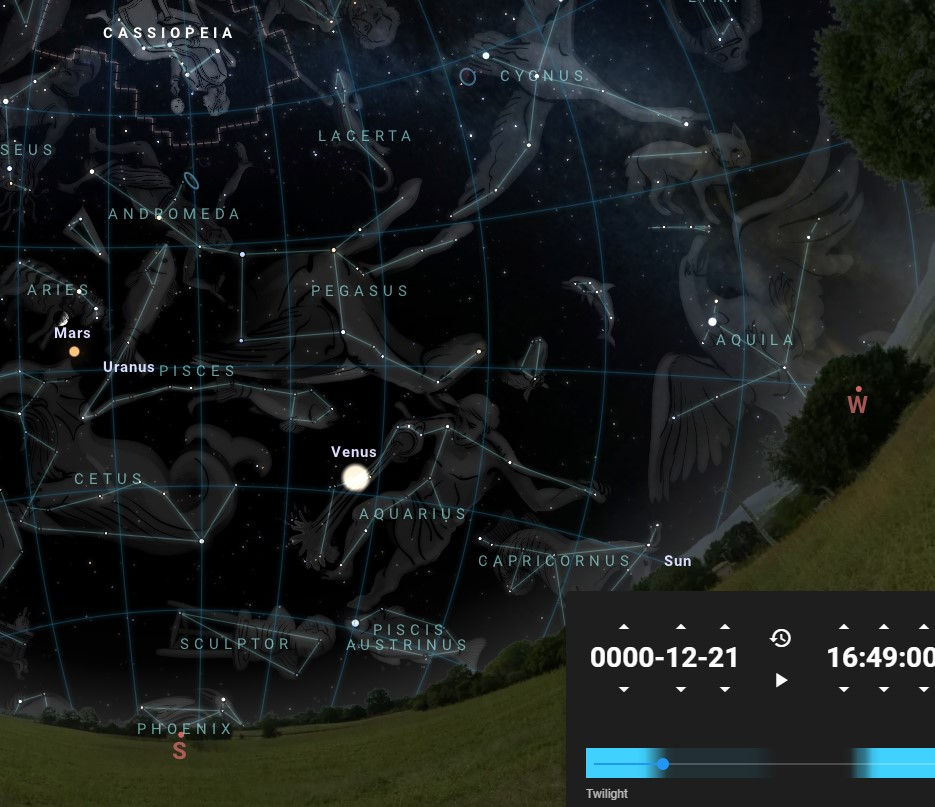
On the longest night of the year, when the sun “dies” and will remain three days in the underworld, the meridian that marks the centre of the visible heavens stretches from the beast that swallowed Jonah in the far south to the great Queen in the far north — exactly the two witnesses Jesus invokes, placed by the Creator at the uttermost ends of the visible cosmos on the very night his own three days in the heart of the earth will begin.
Both references in Jesus's prophecy map to constellations visible in perfect vertical alignment along the southern meridian on the night when the "three days and three nights" will be fulfilled.
Matthew places this prophecy in the Gemini section, at the summer solstice, but encodes it with the winter solstice sky. The prophecy divides the year exactly in half, pointing forward six months from maximum light to maximum darkness, from the sun's highest point to its lowest. Jesus speaks at midsummer about what will happen at midwinter, and the very constellations he invokes—Jonah's fish, the distant Queen—will be visible in alignment on the night of his death. The summer solstice contains the winter solstice. The third sign announces the pattern that will complete in the tenth.
And herein lies the prophecy’s most astonishing reversal. The earthly Queen of the South — the legendary ruler of Saba who rode north on incense-laden camels to test Solomon’s wisdom — has no tomb, no palace, no coin, no inscription. For all the splendour ascribed to her in Scripture, archaeology has never found her. She is a queen who exists only in sacred story, a woman of rumour and text, not of stone or gold. Yet on the winter-solstice night when the sun descends into its three-day tomb, the heavens answer with a queen who needs no caravan, no earthly throne.
Cassiopeia, enthroned at the northernmost reach of the same meridian that cradles Cetus in the far south, rises as the celestial counterpart — the only queen ancient eyes could see standing at the uttermost boundary of the visible world. The mortal queen who came “from the ends of the earth” and vanished from history is fulfilled by the immortal queen who reigns from the opposite end of the cosmic axis on the very night the Son of Man fulfils the sign of Jonah. One queen is legend without proof; the other is light without shadow. Together they frame the longest night of the year, testifying that something — Someone — greater than Solomon has come
Division at the Cosmic Divide
At the moment the year divides, Matthew fills the narrative with warnings about division itself:
"Every kingdom divided against itself will be ruined, and every city or household divided against itself will not stand" (12:25).
The solstice splits the year in half. Jesus articulates this cosmic principle as spiritual law. The Greek word for "divided" (merizō) appears only three times in Matthew's entire Gospel. All three occurrences fall in chapter 12, clustered within two verses (12:25-26), concentrated in this Gemini section. Matthew reserves this vocabulary of division for the exact moment when the sun divides the year at the solstice. The theme is not accidental. The heavens divide. The narrative divides.
The division sharpens when the Pharisees begin plotting to destroy Jesus:
"Then the Pharisees went out, and held a council against him, how they might destroy him" (12:14).
The narrative mirrors the astronomical moment. At the peak of light, darkness gathers its forces. The opposition that will eventually lead to the cross crystallizes here, at the solar summit. The sun cannot remain at its zenith. Decline is built into the structure. The Pharisees' plot begins exactly where it must: at the turning point.
Parables of Division and Duality
Matthew 13 gathers the densest concentration of parables in the entire Gospel. Seven parables unfold in succession, each carrying the Gemini principle: one story with two levels of meaning, one audience hearing two different messages.
Jesus explains this deliberate duality:
"Though seeing, they do not see; though hearing, they do not hear or understand" (13:13).
The same words divide listeners. Some perceive only surface tales. Others glimpse mysteries of the kingdom. Parables function as twins: identical in form, opposite in effect. They reveal and conceal simultaneously. This is Gemini's duplicity enacted in speech.
The parable of the wheat and tares makes the division explicit:
"Let both grow together until the harvest. At that time I will tell the harvesters: First collect the weeds and tie them in bundles to be burned; then gather the wheat and bring it into my barn" (13:30).
In Judea, early June marked wheat harvest, the culminating act of separation. Wheat from chaff. Grain from husk. The useful from the useless. The Gemini principle operates not only in the heavens but in the fields. The solstice season was harvest season, and harvest meant division made visible. What had grown together all spring now faced the winnowing fork. Matthew places this parable exactly where the agricultural calendar demands it.
The parable of the sower (13:3–9) extends the pattern. One seed, four soils. One message, multiple outcomes. The same sun that makes wheat grow hardens clay and scorches shallow ground. Light itself becomes an agent of differentiation.
Healings: Shadows Banished at Maximum Light
Throughout this section, Jesus drives out afflictions with mounting authority. He heals the blind, restores the withered hand, and casts out demons. In Matthew 12:22, Jesus heals a demon-possessed man who was blind and mute, prompting the crowds to wonder if he might be the Son of David. The Pharisees respond by accusing him of working through Beelzebul, prince of demons.
At the solstice, when daylight reaches its maximum, Matthew shows Jesus pushing back every form of darkness. The miracles function as enacted metaphors: illumination at its brightest, shadows scattered. But even here, the pattern of division holds. The same acts that cause some to recognize the Son of David cause others to harden into blasphemy.
The Unforgivable Sin: Division Made Absolute
Within this solstice window, Jesus announces the one sin that cannot be forgiven:
"Anyone who speaks against the Holy Spirit will not be forgiven, either in this age or in the age to come" (12:32).
Here division becomes permanent. Some boundaries cannot be crossed back. The Gemini theme reaches its harshest expression. Light and darkness, forgiveness and judgment, kingdom and exile—these opposites can separate so completely that no return is possible. The twins, once joined, can split forever.
Family Division: Redefining Kinship
Gemini's sibling symbolism comes to the fore when Jesus's own mother and brothers seek him:
"Who is my mother, and who are my brothers? … Whoever does the will of my Father in heaven is my brother and sister and mother" (12:48–50).
Blood kinship divides from spiritual kinship. Biological family separates from chosen family. The ties that bind by nature give way to ties that bind by will. Jesus redefines the most fundamental human relationship, splitting family itself into twin categories: those born of flesh and those born of spirit. The constellation of twins becomes the pattern for a new understanding of belonging.
The Divine Twins Overhead
The constellation Gemini reaches its highest point in the evening sky during late spring and early summer—precisely the period around the summer solstice when the sun reaches its northern peak. Ancient observers would have seen the Twins ascending to their zenith just as the longest days arrived. The sign that governs the solstice is the sign of paired figures.
For Greek audiences, these were no abstract symbols. Castor and Pollux—the Dioscuri—carried one of the most resonant myths in Mediterranean culture. Castor was mortal, born of a human father. Pollux was immortal, born of Zeus. When Castor was killed, Pollux refused immortality without his brother. Zeus granted them a unique fate: they would alternate between Olympus and Hades, one dwelling in light while the other descended into shadow, forever exchanging positions at the cosmic hinge points of the year.
The myth encodes the solstice itself. The Twins do not exist simultaneously in the same realm. They take turns. One rises as the other falls. One presides over the ascending half of the year, the other over the descending half. Their alternation is the division of time.
Matthew's Gemini section echoes this structure with striking precision. Jesus distinguishes between two realms using language that mirrors the Dioscuri pattern:
"I tell you the truth, among those born of women there has not risen anyone greater than John the Baptist; yet whoever is least in the kingdom of heaven is greater than he" (11:11).
The division is explicit. "Those born of women" occupy the mortal realm—Castor's domain. "The kingdom of heaven" is the immortal realm—Pollux's domain. John belongs to the first category, the forerunner who must decrease. Jesus belongs to the second, the one who must increase. The Baptist himself will later articulate this solar law: "He must become greater; I must become less" (John 3:30). One twin yields so the other may rise.
The Church preserved this astronomical logic in its calendar. The Nativity of Saint John the Baptist falls on June 24—three days after the summer solstice, at the exact moment when Gemini stands most prominent in the night sky and the sun begins its six-month descent toward winter. John's feast marks the turning point. From that day forward, light diminishes. Six months later, on December 25, the sun reaches its nadir and begins to climb again. The Christian calendar encodes the twin pattern: John at midsummer's peak, Jesus at midwinter's depth, each presiding over half the solar year.
Luke makes the connection explicit by inventing Elizabeth—a figure unknown to the other Gospels—and anchoring the entire nativity structure on a precise six-month interval between the two conceptions. This is zodiacal counting. Six months. Six signs. The exact distance between solstices. John and Jesus become narrative twins separated by half the cosmic wheel, their mothers' pregnancies synchronized to the same celestial rhythm that governs the alternation of Castor and Pollux.
The Dioscuri were also patrons of sailors, guardians of thresholds, protectors at dangerous crossings. They appeared as twin lights during storms at sea. It is no accident that John's ministry centers on water—the Jordan as threshold, baptism as passage from one state to another. The meeting of John and Jesus at the river enacts the handover between twins: the mortal yields, the immortal emerges, the forerunner steps back as fulfillment steps forward.
Matthew places all of this beneath the sign that makes it visible. At the summer solstice, with Gemini overhead, Jesus teaches division, redefines family, and announces the pattern of three days that will complete at midwinter.The constellation of Gemini does not merely illustrate the section by coincidence. It reigns over it. At the very moment the sun stands still beneath the Divine Twins, Matthew unfolds the longest sequence of deliberate dualities in the entire Gospel, climaxing in the prophecy whose two celestial witnesses will stand six months later at the opposite ends of the same cosmic axis. The heavens and the text speak with one voice
The Gemini Paradox
The themes of Gemini converge with remarkable consistency. The third sign introduces the first mention of three. The year divides at the solstice, and division saturates the narrative. The Greek vocabulary of division clusters in two verses. The prophecy of Jonah divides the year exactly in half, encoding the winter solstice sky into a summer solstice prediction. Parables split audiences. Wheat separates from tares. Demons are cast out while opposition hardens. Forgiveness reaches its limit. Family fractures along new lines. The cosmic pause becomes the moment when every binary sharpens into focus.
For the ancients, the sky was more than backdrop. It was a living text, and the solstice was written into its structure. In Matthew, the longest day of the year becomes the stage for the longest section of parables, the most explicit teachings on division, and the first prophecy of the three days to come. The summer solstice encodes the paradox of Gemini: light at its strongest already carries the seed of its decline. The sun stands still, but only to prepare for its descent. The twins embrace, but only to pull apart. Unity contains division. Maximum light contains the memory of darkness.
The Gospel has reached its zenith. From here, the sun begins its slow return to winter.
![[Post 08] The Markan Foundation: Narrative Shape and the Completion Model](https://static.wixstatic.com/media/e0a3b9_7a71ee36976d469d9921e0f8d5fe8721~mv2.jpg/v1/fill/w_980,h_535,al_c,q_85,usm_0.66_1.00_0.01,enc_avif,quality_auto/e0a3b9_7a71ee36976d469d9921e0f8d5fe8721~mv2.jpg)
![[Post 07] THE WINTER RETURN:](https://static.wixstatic.com/media/e0a3b9_731918ed00b540f18d13435dcb0c0027~mv2.jpg/v1/fill/w_980,h_535,al_c,q_85,usm_0.66_1.00_0.01,enc_avif,quality_auto/e0a3b9_731918ed00b540f18d13435dcb0c0027~mv2.jpg)
![[Post 06] THE AUTUMN RECKONING:](https://static.wixstatic.com/media/e0a3b9_44273715726b4c7ea4ea79842c9c7e44~mv2.jpg/v1/fill/w_980,h_535,al_c,q_85,usm_0.66_1.00_0.01,enc_avif,quality_auto/e0a3b9_44273715726b4c7ea4ea79842c9c7e44~mv2.jpg)
Comments